


Snohomish County Housing Market Update – April 2026

Updated: May 17
If you’re a buyer, seller, or homeowner wondering what your place might be worth now and later this year, the April numbers for this Snohomish County housing market paint a pretty interesting picture.
Snohomish County still looks active, but it is clearly less overheated than it was a year ago.
Inventory is up, a lot, new listings are rising, buyers appear a bit more selective, and prices have flattened rather than surged. That does not mean the market is weak. It means the market is becoming more balanced.
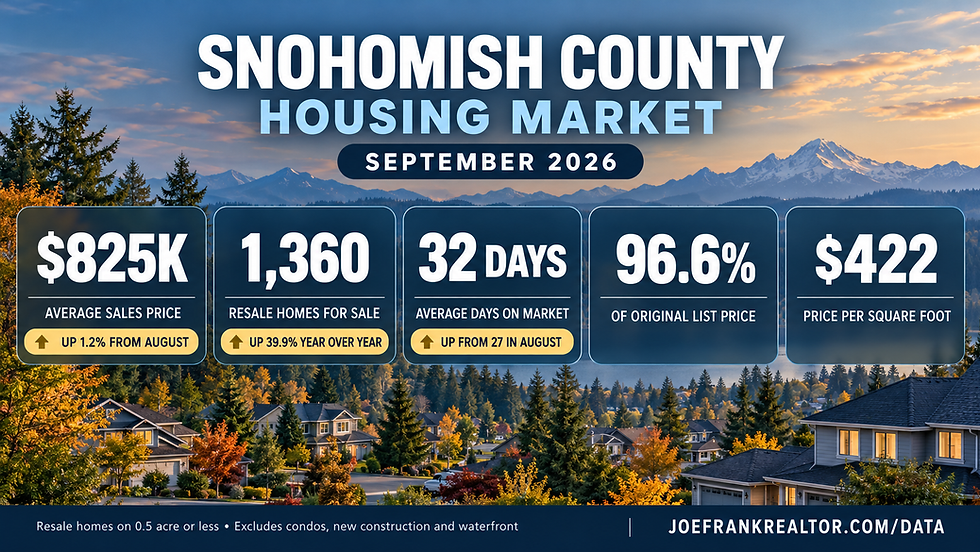
Please note the following analysis that includes local Snohomish County market data excludes condos, new construction, waterfront homes, and homes on more than 0.5 acres.
For the latest local housing data and trends from Snohomish, Skagit, and King Counties, as well as other key real estate and economic data, visit: JoeFrankRealtor.com/data

What the April 2026 Snohomish County Housing Market Data Is Saying
Average Sales Price slipped from $825,000 in March to $824,500 in April, a change of about -0.1%. Year over year, that is down from $868,000 in April 2025, or about -5.0% YoY.
This indicates pricing has gone mostly sideways month to month, but the market is still below last year’s higher spring pricing. One likely reason is that buyers now have more choices and slightly more negotiating power than they did a year ago. Over the next 3 to 6 months, this may signal modest price stability rather than a strong upward jump, unless mortgage rates improve meaningfully.
New Listings rose from 656 in March to 826 in April, an increase of about +25.9%. Compared with April 2025 at 615, that is +34.3% YoY.
This is one of the biggest signals in the data. More homeowners are deciding to test the market, which gives buyers more selection. If this continues into late spring and early summer, sellers may need to be a little more strategic on pricing and presentation than they did last year.
Total Homes For Sale jumped from 652 in March to 892 in April, an increase of about +36.8%. Compared with 469 one year ago, inventory is up a huge +90.2% YoY.
That is a major shift. Inventory nearly doubling from a year ago does not automatically mean prices will fall sharply, but it does mean buyers have more breathing room. Over the next 3 to 6 months, this could keep price growth muted and create more leverage for buyers on inspection items, repairs, or seller credits.
Days on Market fell from 24 in March to 21 in April, a change of -12.5%. But compared with 13 days in April 2025, that is +61.5% YoY.
Homes are still selling faster than they did last month, which is normal in spring, but much slower than last year’s frenzy. The takeaway: desirable, well-priced homes can still move quickly, but buyers are not chasing everything the way they were in spring 2025.
Final Sales Price as a percentage of original list price increased from 99.0% in March to 99.8% in April. That is about a +0.8% change month to month, or up 0.8 percentage points. Compared with 101.2% a year ago, it is about -1.4% YoY, or down 1.4 percentage points.
This is a big behavioral clue. Homes are still selling very close to asking price, which shows demand remains solid. But compared with a year ago, buyers are no longer routinely paying over original asking price. Over the next few months, accurate pricing should matter even more.
Price per Square Foot declined from $440 in March to $429 in April, a change of -2.5%. Compared with April 2025 at $429, no change.
This suggests values on a size-adjusted basis were basically flat from a year ago. That points to a market that is digesting more supply rather than one that is rapidly appreciating. For homeowners, it likely means values are still respectable, just not accelerating the way they did in stronger seller-market periods.
Shows to Pending dropped from 13 in March to 11 in April, a change of -15.4%. Compared with 12 one year ago, that is -8.3% YoY.
Buyers are still active, but they appear more selective. Fewer showings are needed to get a home pending than last month, but slightly more than the hottest periods. Over the next 3 to 6 months, this could mean homes that are clean, well marketed, and priced right still do fine, while homes that miss the mark may sit longer.
What May Be Driving These Changes Right Now
Mortgage rates are still one of the biggest swing factors. Freddie Mac said the average 30-year fixed mortgage rate was 6.37% as of May 7, 2026, up from 6.30% the week before. Freddie Mac also noted that higher inventory and softer new-home pricing could help ease affordability pressure somewhat this spring. Mortgage News Daily reported a rate of 6.42% as of May 8, 2026
The Federal Reserve kept its policy rate in a 3.5% to 3.75% target range following its April 29, 2026 meeting. That matters because if inflation stays sticky, mortgage rates may not fall quickly, even if buyers and sellers badly want relief.
Buyer demand has not disappeared, but it has become more rate-sensitive. In the MBA’s latest weekly survey, the unadjusted Purchase Index was down 3% week over week but still 5% higher than the same week a year earlier. This fits what our local data suggests: buyers are still in the market, but they are more cautious and more payment-conscious.
Nationally, the housing market is also showing signs of a more buyer-friendly setup than last year. Realtor.com reported that in April 2026, active listings were up 4.6% year over year, the national median list price was down 1.4% year over year, and 16.7% of listings had a price cut, though that was actually lower than a year ago.
In plain English: more supply is showing up, but many sellers are pricing more realistically from the start.
The Bigger-Picture Risks To Affordability
The broader economy is still a wild card. On May 8, Reuters reported that the Fed’s latest financial stability report identified geopolitical risks and the oil shock tied to the current Middle East conflict as top concerns, warning that a prolonged conflict could push up inflation and slow growth. Higher energy costs can feed into inflation and keep interest rates higher for longer, which is not great for housing affordability.
Tariffs are another affordability issue to watch. NAHB says tariffs on building materials raise the cost of housing and that builders estimate recent tariff actions have added about $10,900 per home, with more than 60% of builders reporting higher costs from tariffs.
Reuters also reported in April that builder sentiment fell to a seven-month low as higher material costs, elevated mortgage rates, and economic uncertainty weighed on the sector.
Even with that pressure, some national forecasters still expect affordability to improve gradually if rates drift lower. Zillow's outlook assumes mortgage rates will hover near 6% by the end of 2026, while income growth outpaces modest home-value growth, helping affordability improve in many markets. That does not guarantee relief in expensive areas like ours, but it does support the idea that 2026 may be more about stabilization than another major affordability collapse.
What This Could Mean For Snohomish County Over the Next 3 to 6 Months
For Sellers
You can still do very well, but pricing correctly from day one matters more now.
With inventory up sharply, buyers have more options, so homes that are overpriced or poorly presented may lose momentum faster.
The good news is that homes are still selling close to asking price when they are marketed well.
For Buyers
You likely have more choices and a little more negotiating room than you did a year ago.
You may not need to chase every listing with the same urgency as spring 2025.
That said, the best homes will probably still move quickly, especially if they are updated, well located, and priced right.
For Homeowners Wondering What Their Home Is Worth
Your home may still be worth a very solid amount, but the market is acting more like a normalizing spring market than a runaway seller market.
Broad county averages are helpful, but your home’s true value will depend heavily on location, condition, size, layout, updates, and nearby competition.
In a market like this, hyper-local pricing matters a lot more than broad headlines.
Bottom Line
April 2026 looks like a healthier and more balanced Snohomish County market than the one we saw a year ago. Inventory is up, listings are up, and buyers are more selective, but demand is still there. Prices do not look like they are collapsing. They look like they are flattening and becoming more sensitive to rates, affordability, and competition.
That likely means the next few months will reward:
Smart sellers who prepare and price well.
Patient buyers who stay ready.
Homeowners who want a realistic, local view of value rather than just relying on broad county averages.
Reference links
Thanks for reading!
Please reach out if you have any questions or help needed. You can also dig into the data and trends yourself at JoeFrankRealtor.com/Data.
Cheers!
-Joe
You can listen to the podcast for this article below. Please note that the podcast is AI generated from this blog article.


Comments